
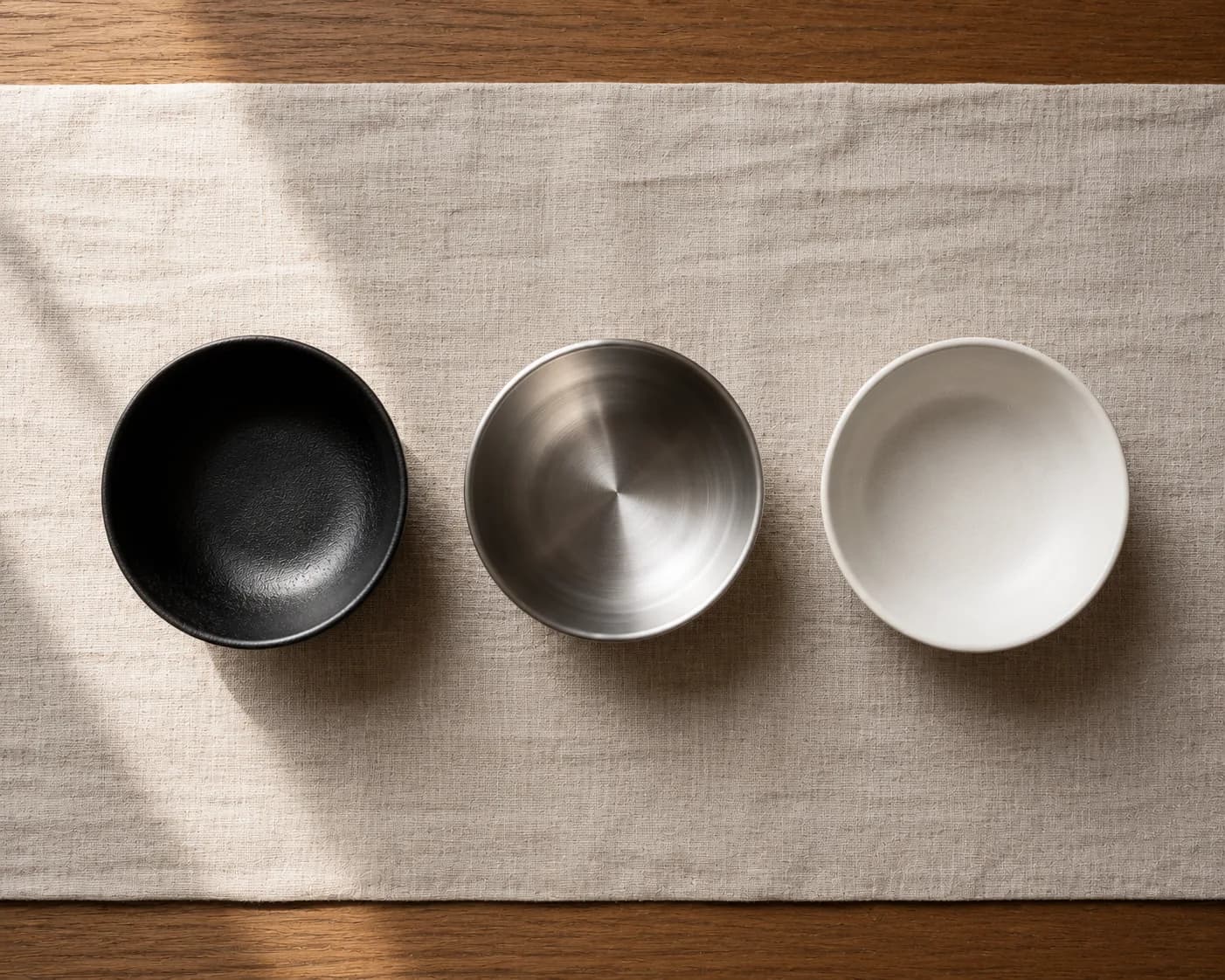
Open the third drawer in your kitchen and you're looking at one of the most under-appreciated material-science exhibits in your house. Most of us inherited this drawer from our parents. Almost nobody knows what they're cooking with.
Here's the short tour.
Stainless steel
Iron, with chromium added so the surface forms a self-healing oxide layer that resists rust. The chromium is doing almost all the work; that's why "surgical stainless" and "food-grade stainless" differ mainly in chromium content. It's not a passive material. It's a material that's actively repairing itself every time you wash it.
Cast iron
Mostly iron with a higher carbon content than steel. The high carbon makes it brittle but also dramatically heat-retentive. The "seasoning" you've been told to maintain is, mechanically, a layer of polymerized fat — a thin plastic coat that you bonded to the surface through heat. Once you understand that, the maintenance rules stop feeling like folklore.
Ceramic and stoneware
Mineral clays, kiln-fired at temperatures hot enough to vitrify the structure. The glaze on top is a glass layer applied separately. Stoneware survives temperature swings better than porcelain because of larger crystal structures that absorb thermal stress.
The one doing more work than you think
Aluminum. Cheap, light, conducts heat better than almost anything you can afford, and is what most professional kitchens reach for first. The reason you don't see it celebrated is that it doesn't photograph as well as cast iron. The food does not care.
Open the drawer with new eyes. There's a century of metallurgy in there, hiding.